
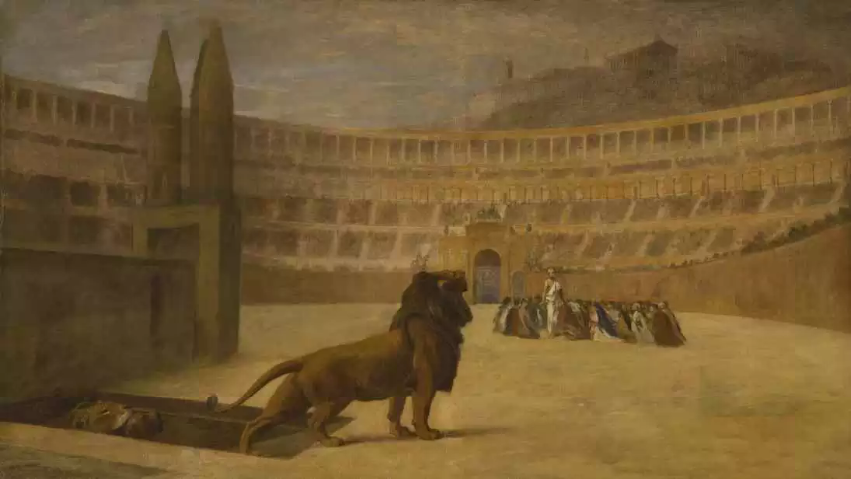
In the first and second centuries, throughout the Roman Empire, numerous emporors and governors demanded that all Romans subjects come annually to a temple dedicated to the Roman emperor–they were all over the empire–to pray and sacrifice for the well-being of the emperor and the empire by burning a pinch of incense.
The Roman emperors were not a “jealous god.” They didn’t really care what other gods you worshipped, as long as you also showed you were a good member of the society by offering prayers for the demi-god emperor. If you were a Christian, and worshipped that executed rabble-rousing rabbi from the outer edges of empire, that was fine. Do your thing. Just recognize the cult of emperor as well.
Of course, that was, indeed, a problem for the Christians of that era.
In recent years we’ve seen the emergence of a new global religion that demands similar levels of recognition. The cult is the 2SLGBTQ++ Acceptance Regime. At the heart of it lies the demand that we all affirm that gender is a “social construct” and biological sex is not “binary” that is, male and female; XX and XY; masculine and feminine.
Like the Roman emperor cult, the new religion doesn’t mind if you hold to other faiths. All you have to do to keep your teaching job at the university or in the giant corporation is sit through the Diversity and Inclusion Seminar and sign the documents that you affirm certain wildly unscientific things to be true.
Similarly, all you have to do to keep your posting privileges on Facebook is avoid pointing to something objectively false and saying, “That’s nonsense.”
In other words, just burn a pinch of incense. It’s not a big deal.
Do you want to know who thought it was a big deal, the first and second century Christians.
The Second Century church father, Tertullian is best known for declaring, “The blood of the martyrs is the seed of the Church.”[1] Today, you don’t die in the arena. You just–as ESPN’s Samatha Ponder recently discovered–lose your job because you spoke out in favor of keeping women’s sports to biological women only.
The story of the early Church is one of blood and sacrifice. Few of the Jesus movement’s first wave of leaders escaped a martyr’s fate. Stephen and James died for the cause of Christ in Jerusalem very early in the Gospel story. Both Paul and Peter were executed under Nero in Rome in A.D. 66 or 67 in the midst of the first systemic, empire-wide wave of Christian persecution.
Early North African Martyrs
A casual American visitor to the thoroughly Islamic nation of Tunisia might be surprised to come across an American war cemetery nestled in one the suburbs of Tunis. But one lies there all the same.
Head roughly five miles northeast from the bustling city center toward the coast and you’ll find yourself in the suburb of Carthage, where high rise apartments line the rocky beaches and neat rows of modern buildings are occasionally interrupted by a minaret-ed mosque or a Roman-era ruin. A few turns off the main highway, you get a hint that something unusual lies ahead when you turn onto a street the former French colonial government named, “Route de Roosvelt”.
Soon you encounter a large patch of bright green amid the predominant browns and grays of the Tunisian landscape. This is the 27-acre North Africa American Cemetery and Memorial, the resting place of 2,841 of America’s war dead. Bright white headstones organized with military precision sit at attention in straight lines, subdivided into nine rectangular plots by wide paths, with decorative pools at their intersections. This startlingly lovely, meticulously manicured place holds the remains of U.S. soldiers who fell in the fierce fighting between the Allies and the Axis powers in North Africa in World War II. Men like Corporal Stanley J. Abromski from New Jersey, Second Lieutenant Kenneth W. Baker from Kansas, and Seaman Second Class Lyle J. Wozniak from Wisconson rest here in Carthage, a very long way from home.
Scarcely more than a stone’s throw from that hallowed ground, on top of a small, grassy hill between the cemetery and the sea, you’ll find another burial site. This is an ancient and significant burial ground, but to find it, one has to know where to look. Untended, unmarked, and largely unknown to the locals, it’s easy to miss.
The stones and mud bricks strewn here represent the remnants of a great church. The Basilica Maiorum once stood on that spot to hallow the burial site where, in A.D. 203, two young Christian women and their companions happily chose death rather than violate their consciences by burning incense in worship of the Roman emperor.
Half buried in the hillside is a slab of marble inscribed with Latin letters. It reads:
Here are the martyrs
Saturus, Saturinus,
Revocatus, Secundulus,
Felicitas, Perpetua, who suffered on the Nones (7th) of March[1]
Perpetua was a twenty-one-year-old mother with a nursing infant who had recently embraced Christianity. She was a catechumen, meaning that she was in the midst of a period of instruction about the faith as preparation for baptism.
It would be hard to find a more noble and heroic woman in all of church history than Bivia Perpetua of Carthage, who was arrested for her faith and thrown to the wild beasts in AD 203 . . . A personal encounter with Perpetua is possible for us today because she, unlike most women in the ancient church, has left a written record of her thoughts.[2]
It’s true. Perpetua and her pregnant servant girl Felicity were swept up in one of the Roman Empire’s periodic local outbreaks of persecution and imprisoned. Perpetua kept a detailed journal of her experience. Her unbelieving father repeatedly pleaded with his daughter to recant her Christian faith and live, but she would not. She was baptized while imprisoned. Her friend Felicity gave birth to her first child, a baby girl, while awaiting execution.
Some months later—as the highlight of the birthday festivities honoring the visiting Roman Emperor Septimius Severus—Perpetua, Felicity and the others were killed by wild beasts in an arena, as pagan Carthaginians looked on for entertainment. Yet, these are not the earliest Christian martyrs of North Africa whose names are known to us. Nor are they the first women.
Most of their names remain quite unfamiliar. Listen: Januaria, Generosa, Vestia, Donata and Secunda. Note that all these were women. These five were among the earliest African martyrs in A.D. 180 . . . There were many other martyrs, both men and women, whose names are largely unknown: Mina, Lucius, Theodorus, Cyrilla and Helladius. The last of these was burned to death in a furnace in Libya. These names do not spring quickly off the tongue, but their African blood was shed on their native continent.[3]
At her trial, Donata is reported to have said, “We render honor to Caesar as Caesar, but worship and prayers to God alone.”[4]
Ninety-five years later and 1400 hundred miles farther west, in what is today the nation of Morocco, the story of another Christian martyr comes down to us. “During a festival at Tangier (Africa) in honor of the birthday of the Emperor Maximian Herculeus, a centurion by name Marcellus refused to take part in the religious (Pagan) rites and, declaring himself a soldier of Christ, the Eternal King, threw down his arms and insignia, and that he was thereupon arrested and imprisoned and in the end beheaded (A.D. 298).”[5]North Africa’s soil received the blood and bodies of countless other unknown, unnamed believers in the first three or four centuries of the Church’s existence. Yet the movement continued to thrive there.
[1] Susan Raven, Rome in Africa (city, Routledge, 2012) 153.
[2] Bryan M. Litfin, Early Christian Martyr Stories: An Evangelical Introduction with New Translations, (Grand Rapids, Baker Academic, 2014) .91
[3] Thomas C. Oden, Early Libyan Christianity: Uncovering a North African Tradition (Downers Grove, IL: IVP, 2011), 16.
[4] Ed. William Smith and Henry Wace, A Dictionary of Christian Biography, Literature, Sects and Doctrines Being a Continuation of the Dictionary of the Bible, Vol. 2 (London, William Clowes and Sons, 1877) 501.
[5] Monks of Ramsgate. “Marcellus,” Book of Saints (London: A & C Black, 1921), 178.
[1] Tertullian. Apologeticus. Chapter 50. Online: http://www.earlychristianwritings.com/text/tertullian01.html. Accessed 1/7/2018.